The Landscape Of Alternative Provision Is Changing
With the publication of the Non-School Alternative Provision Voluntary National Standards in August 2025, the government has signalled a significant shift in expectations for AP providers. While these standards remain voluntary for now, the intention is clear that they will become mandatory when parliamentary time allows; and commissioners are already being encouraged to adopt them.
For many non-school alternative provision settings, particularly those specialising in social, emotional, and mental health (SEMH) support, whilst this represents a challenge, it could also be an opportunity:
- The challenge? Demonstrating that therapeutic, behaviour-focused and vocational interventions are also delivering robust academic progress aligned with the National Curriculum.
- The opportunity? Using innovative tools to show this alignment in ways which are meaningful, measurable and manageable.
The New Reality: Quality of Education Standards for AP
Part 4 of the new National Standards focuses specifically on ‘Quality of Education.’ The standards require providers to ensure that teaching staff and instructors have appropriate skills, knowledge and qualifications to deliver programmes. More significantly, commissioners are expected to ensure that placements “provide education in line with that of their home school, to better enable reintegration.”
For settings which have built their reputation on delivering outstanding SEMH outcomes through sports programmes, outdoor education, creative arts or vocational training, this raises an important question: how do we demonstrate that a young person learning carpentry, managing anxiety through art therapy, or building confidence through equine activities is also developing skills in maths, English, science and other curriculum areas?
The answer isn’t to abandon what works. It’s to make the academic learning which is already happening visible, trackable and evidence-based.
The Hidden Curriculum: Academic Skills in Non-Academic Tasks
In reality young people in alternative provision are often developing core academic skills through their everyday activities; it’s just that they’re not framed or recorded that way.
Consider these examples:
- A carpentry project involves measuring lengths (maths), reading technical drawings (geometry and spatial reasoning), calculating costs and materials (numeracy and budgeting) and writing up safety procedures (literacy and technical writing).
- A sports session requires calculating match time and rest periods depending on the sport (time and number), understanding nutritional information (science and data interpretation), tracking fitness progress over time (data handling and graphs) and reflecting on performance (analytical writing).
These are all real academic competencies which young people are building every day. The issue is that they don’t realise it and without a systematic way to identify, tag and track these skills, they remain invisible to commissioners, Ofsted and even the young people themselves.
How Kloodle Makes Academic Learning Visible
Kloodle is designed to capture and showcase skill development across all activities. Here’s how it helps non-school AP providers align their SEMH-focused work with National Curriculum expectations:
- Custom Skills Frameworks with Curriculum Alignment: Providers create bespoke frameworks which include both SEMH competencies and academic skills mapped to National Curriculum areas. When young people upload evidence, such as photos of completed work, video reflections, blog posts, they tag them with relevant skills from both categories. This dual tagging means every activity contributes to both therapeutic outcomes and academic progress, recorded in real time.
- Evidence-Based Progress Tracking: Kloodle’s portfolio approach allows students to build a visual, living record of their work. Young people upload photos, videos, written reflections, and graphs tracking development. Each piece is tagged with demonstrated skills, creating a clear trail showing not just therapeutic progress, but academic learning outcomes.
When commissioners ask about curriculum coverage, you can point directly to the evidence.
- Individual Learner Plans: Rapid Progress with Lasting Impact – One of Kloodle’s most powerful features for alternative provision is its ability to create and track individualised learner plans which drive quick, substantial progress during short-term placements, and crucially, create a legacy which receiving schools can build upon.
- AI-Powered Initial Assessment and Target Generation: When a young person arrives at your AP setting, Kloodle’s AI can analyse uploaded documentation, such as referral forms, previous assessments, EHCPs, behaviour support plans, and generate personalised targets within minutes. These aren’t generic goals; they’re specific, actionable targets aligned to the individual’s needs and the curriculum areas they need to develop.
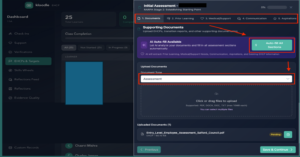 Example: Initial assessment with document upload and AI generation
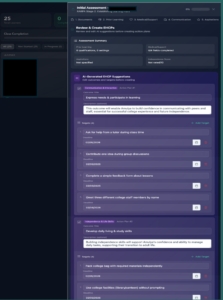 Example: AI-generated action plan with SMART targets linked to needs
- Real-Time Progress Monitoring: Throughout the placement, every activity and reflection is automatically linked to relevant targets. Staff and young people can see immediately which targets are being worked on, which skills are developing and where additional focus is needed. This real-time visibility means interventions can be adjusted rapidly, especially important when placements may only last 6-12 weeks.
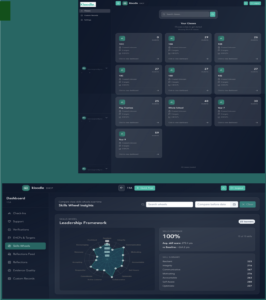 Example: Dashboard showing real-time learner progress and analytics
The Legacy Handover: Enabling Continuity
Here’s where Kloodle transforms reintegration. When a young person returns to their mainstream school, they don’t leave with a paper report that gets filed away. They carry a comprehensive digital profile which the receiving school can immediately access and build upon:
- Complete record of all targets set and progress made against each one
- Evidence portfolio showing exactly what curriculum areas were covered and how
- Visual skills wheels showing growth across SEMH and academic domains
- Recommended next steps and continuing targets ready to implement
- Strategies which worked (and didn’t work) for this specific young person
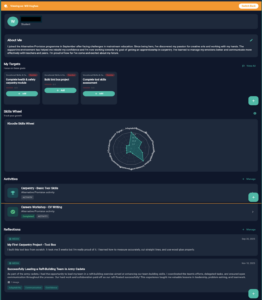
Example: Learner profile showing targets, skills wheel and evidence ready for handover
The receiving school doesn’t have to start from scratch. They can log into the platform, see exactly where the young person is developmentally, understand what interventions were effective and continue the trajectory of progress without missing a beat. The young person’s AP placement becomes a valuable chapter in their educational journey, not a gap that needs explaining.
This continuity is invaluable. It means the substantial progress made during an AP placement isn’t lost. It demonstrates to commissioners that your setting is an active contributor to long-term educational success rather than a holding pattern.
A Practical Example: The 0161 Project
The 0161 Project in Manchester demonstrates exactly how this works in practice. This boxing-based alternative provision serves many young people in the area who are at risk of exclusion or facing SEMH challenges. While boxing is the hook which engages young people, the programme incorporates mentoring, vocational training and life skills development.
Using Kloodle, the 0161 Project tracks how each activity, from gym sessions to mentoring conversations to accredited vocational units, contributes to both SEMH outcomes and academic skill development. A boxing training session might be tagged with skills including:
- Resilience and self-discipline (SEMH)
- Understanding of cardiovascular health and fitness (science)
- Calculating training zones and heart rates (maths)
- Written reflection on performance (literacy)
This comprehensive tagging means that when commissioners review the placement, they can see clear evidence of curriculum-aligned learning happening alongside the therapeutic work. The digital platform turns “just boxing” into a rich educational experience with demonstrable academic outcomes.
As the 0161 Project team noted: “The Kloodle team has been exceptional in tailoring the platform to meet the specific needs of our students.” This flexibility is crucial. Every AP setting is different and the ability to customise frameworks to reflect each provider’s unique offer is what makes Kloodle effective.
Preparing for Mandatory Standards
While the National Standards are currently voluntary, the direction of travel is clear. When they become mandatory, providers will need robust systems in place to demonstrate compliance. Starting with Kloodle now means:
- Building a historical record of curriculum-aligned learning outcomes
- Embedding skills-tagging into daily practice so it becomes routine, not an additional burden
- Creating evidence-rich portfolios that can be shared with commissioners, schools, and inspectors
- Demonstrating to young people themselves that their learning has value and counts toward their future
- Positioning your provision as forward-thinking and quality-assured
Early adopters will have competitive advantage when commissioning decisions are made. Providers demonstrating clear curriculum alignment alongside outstanding SEMH support will be the ones schools and local authorities choose.
Your Work Already Meets the Standards: You Just Need to Show It
If you’re running a high-quality alternative provision focused on SEMH outcomes, the chances are you’re already helping young people develop academic skills. You just might not be framing or recording it that way. The new National Standards don’t require you to become a traditional school. They require you to demonstrate that the education you’re providing has academic value alongside its therapeutic value.
Kloodle provides the framework and the evidence base to do exactly that. By making it easy for staff and students to tag activities with both SEMH and academic skills, by creating visual representations of holistic development, and by providing real-time data for commissioners, Kloodle bridges the gap between intervention and curriculum.
As the sector evolves, the providers who thrive will be those who can demonstrate their impact comprehensively. With Kloodle, you can show that a sports programme isn’t just about fitness and behaviour, it’s about maths, science, literacy, as well as personal development. That outdoor education offers more than building confidence, it’s supports learning in geography, data handling and communication skills. Vocational training isn’t separate from academic learning, instead it’s a powerful vehicle for it.
The work you’re doing changes lives. Now you can show exactly how it also changes educational outcomes.
* * *
To find out more about how Kloodle can help your alternative provision setting meet the new National Standards, visit homepage.kloodle.com or contact the team to arrange a demonstration.
