How AI Is Turning a Special Needs Tool Into Every Student’s Secret Weapon
By Neil Wolstenholme, Chairman of Kloodle
A friend of mine, who teaches at a secondary school in Lancashire, told me something recently which stopped me in my tracks: “We spend weeks creating personalised plans for our EHCP students, and they’re brilliant. But for the other 90%? They just get the same generic targets as everyone else.” It’s a fair point. It’s one that goes to the heart of a question we should all be asking: why should personalised learning be a luxury reserved for the few?
For years, personalised plans have been the preserve of students with special educational needs, delivered through EHCPs (Educational Health and Care Plans). These are important, painstaking documents. However, technological advances, particularly in artificial intelligence, mean we can now efficiently and effectively provide every young person with tailored guidance for their personal educational journey. We can do it at relatively low cost, efficiently and pretty much in real-time. It’s not a pipe dream; it’s possible right now.
Why Every Student Deserves A Plan
Every young person deserves clear direction as they progress through education. A personalised learning plan (PLP) provides structure, tracks progress and creates an audit trail which follows a student throughout their academic journey and beyond. Yet until now, these plans have been largely limited to those with EHCPs, action plans for students with identified special needs who receive targeted support with specific objectives.
The question hasn’t really been whether learning plans are valuable, it’s been one of resources and practicality. How on earth can schools create, maintain and update personalised plans for hundreds or thousands of students without burying teachers in the quagmire of bureaucracy? As Professor Phil Cummins articulates it: “Every child should have a personal learning plan to guide their journey. In the past it’s been too hard to do this – too bureaucratic – but now we have the technology”.
The Technology Breakthrough
Traditional EHCPs illustrate the challenges perfectly. These plans, 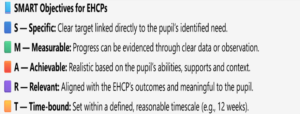 which set targets and allow students to upload evidence of progress against SMART objectives, have been hampered by outdated systems. Paper-based processes between schools and councils mean updates can take months, even years, rendering plans rigid and outdated rather than responsive to students’ actual needs.
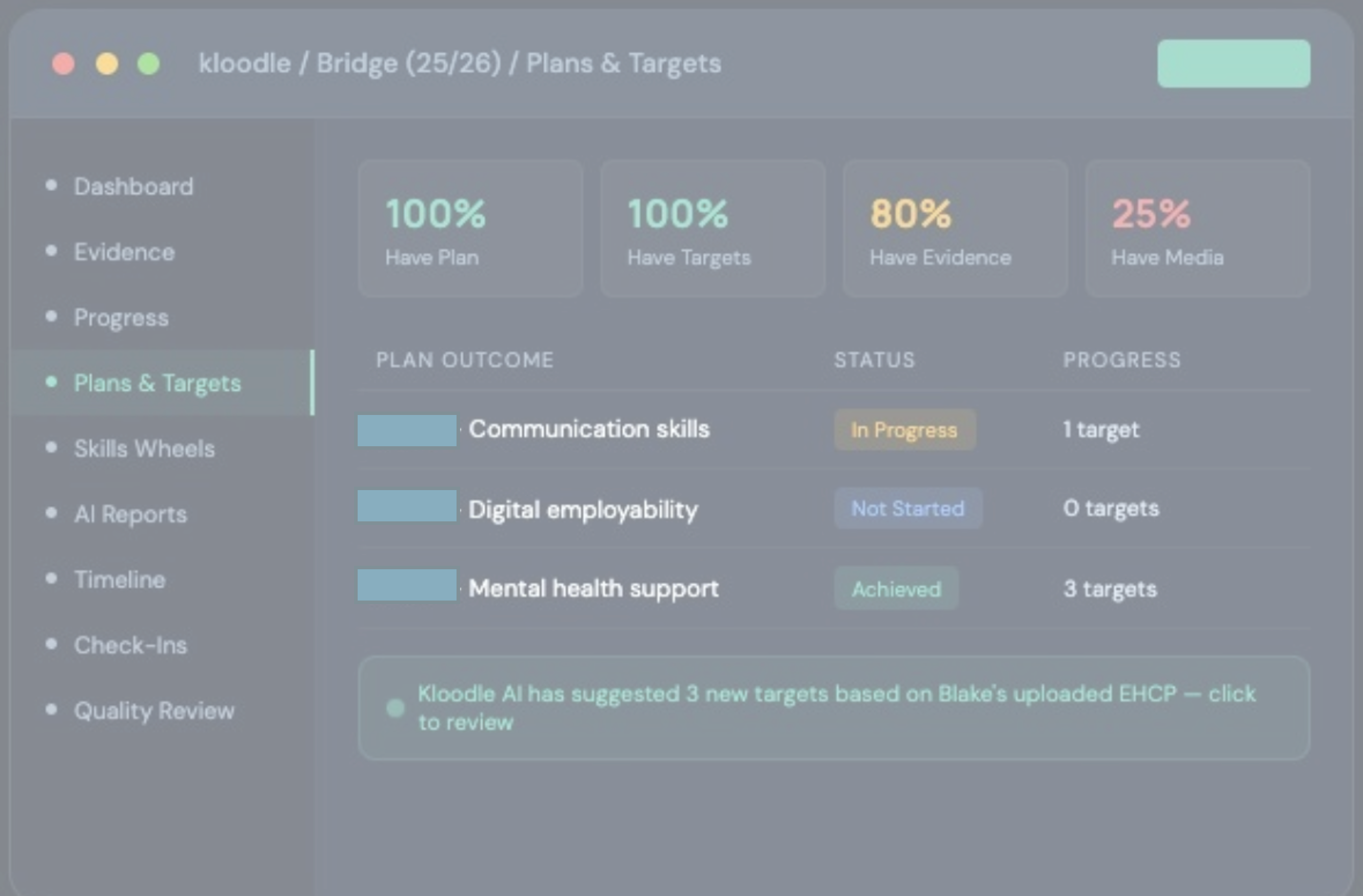
This is where AI changes everything. Machine learning systems can look across entire cohorts of numerous students, identifying trends, suggesting interventions and automating the routine stuff. At Kloodle, the AI engine under the bonnet analyses patterns across all lessons and students, providing teachers with intelligent, immediate insights and progress tracking. Crucially, it thereby frees up the time teachers so desperately need for what actually matters: direct student interaction and creative thinking.
What was once too resource-intensive for all students is now not only possible but also practical. It’s a textbook example of how innovations developed for niche applications can scale to serve everyone; the expertise gained from supporting students with special needs has created systems robust enough to benefit all learners.
Connecting Education With Employment
Now here’s where it gets really interesting. Perhaps the most exciting potential of universal PLPs lies in bridging that persistent gap between education and employment. When every student has a digital personalised learning plan, employers can actively participate in shaping young people’s development by requesting the specific skills and character traits they value and need, and the PLPs can align accordingly.
Think about it: rather than abstract educational objectives or qualifications which leave employers scratching their heads, students can work toward practical, real-world ‘employability’ targets. An employer in manufacturing might specify problem-solving, attention to detail and teamwork. A tech company might prioritise adaptability, digital literacy and communication. Schools can incorporate these requirements into individual PLPs, creating clear pathways from classroom to career. The AI does it all for them!
And before anyone objects – this doesn’t mean reducing all education to vocational training. Character traits like resilience, integrity, empathy and leadership remain absolutely central and can form part of a student’s PLP – it means that students can see the direct connection between what they’re developing in school and where they want to end up; and or employers, it creates unprecedented visibility into a young people’s actual capabilities in language and with supporting evidence they can relate to. Rather than relying solely on the outdated channel of exam results and CVs, which due to factors like grade inflation are increasingly unreliable anyway, they can see real evidence of specific skills’ development and character growth.
How The Platform Works
The diagram below illustrates how an AI-powered platform like Kloodle connects all the key players – employers, educators and students – in a continuous cycle of skills’ and character development directed by real employer needs:
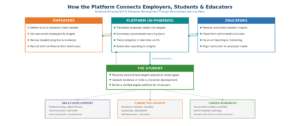
The beauty of this model is its clarity and alignment. Employers define what they need. The platform translates those needs into personalised student targets. Students develop skills and character, uploading evidence as they go. Teachers get real-time insights without drowning in paperwork. And the whole thing loops back around, continuously refining and improving. Everyone’s a winner!
What Students Actually Get Out Of This
For students, this boils down to three things.
First, clear direction. Rather than drifting through education without clear goals, they have specific targets aligned with their aspirations. They know what they’re working toward and why it matters.
Second, evidence. Every achievement, every skill developed, every challenge overcome is documented. This builds a powerful portfolio which students carry forward with them in their PLP to demonstrate their growth to universities, employers and themselves. The audit trail shows not just where they’ve arrived, but how they got there.
Third, opportunity. When employers specify the skills and character traits they value, students can proactively develop those qualities. The pathway from classroom to career becomes visible and actionable, reducing the uncertainty that so many young people face when they leave education. Let’s face it, that uncertainty is one of the biggest challenges of our time.
A New Standard
Technology has removed the resource constraints which  previously made universal personal learning plans impractical. What was once only possible for a subset of students can now extend to everyone. By connecting individual PLPs directly to employer needs, we create a system where education and employment finally speak the same language. Students develop skills and character that employers actually value. Employers gain access to well-prepared candidates. And society benefits from young people who transition smoothly from education to productive careers.
The question is no longer whether every student should have a personalised learning plan. The question is how quickly we can make this the standard rather than the exception. We’re ready! Are you?
If you would like a demo of Kloodle please book it here: https://calendly.com/kloodle/30min?back=1
Or, alternatively, contact me at neil@kloodle.com
